 CaixaUnica
How to declare crypto on your Brazilian tax return (Bitcoin, Ethereum and Binance) without spreadsheets
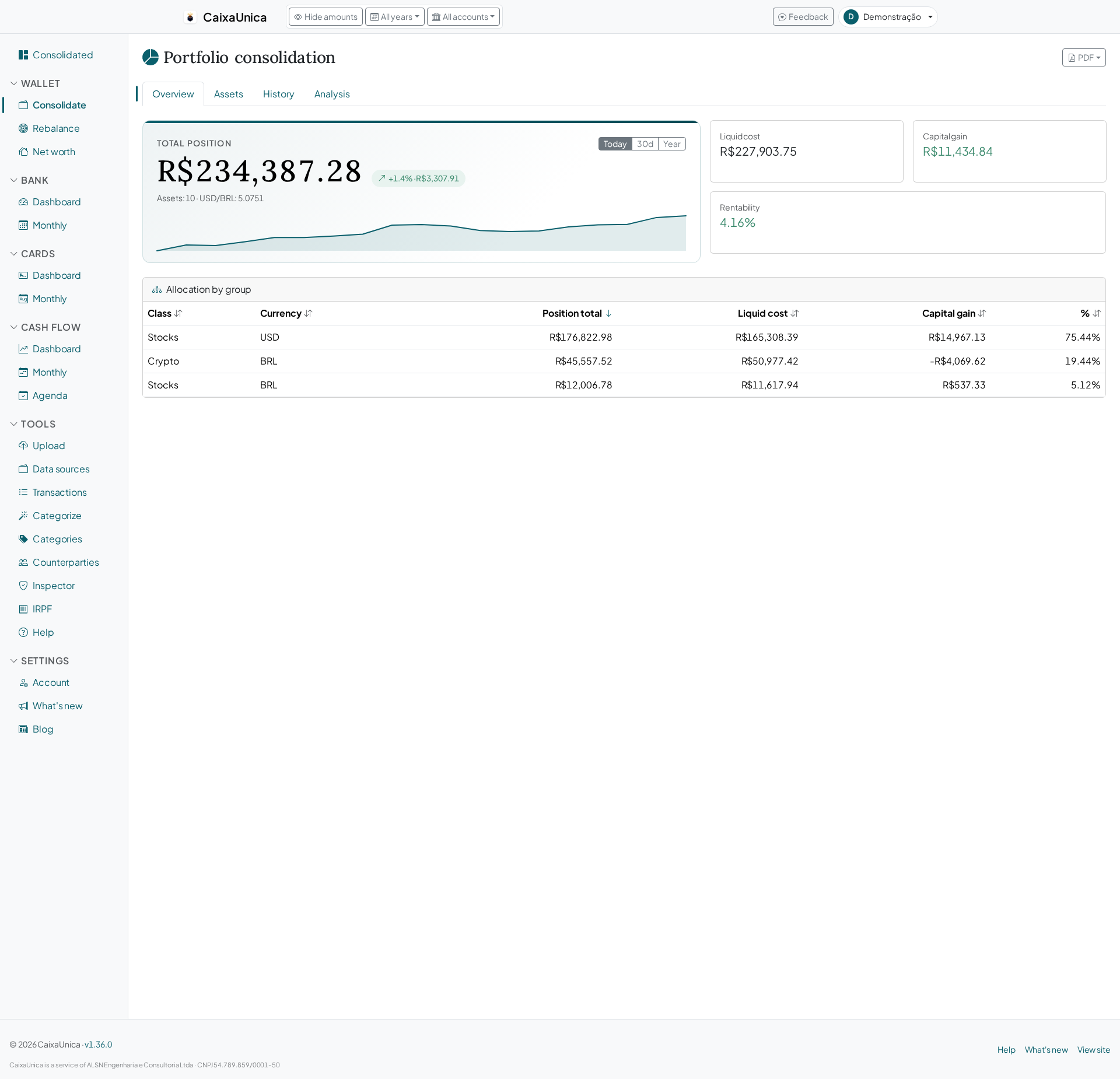
Crypto is one of the most confusing parts of the Brazilian income tax (IRPF). The rules exist, but the grunt work is heavy: remembering the cost of each purchase, adding up a full year of trades, separating your year-end position from sales with a profit. CaixaUnica handles the tedious part — you import your Binance statement (and other exchanges) and it consolidates positions, computes the average cost and lays out the IRPF fields.
Important: CaixaUnica is not an exchange. You don't buy or sell crypto here. It reads the statements you already export from your exchange and delivers the right numbers, organized into the tax-return sections, for you to review and enter in the tax authority's software.
When you must declare crypto
Two different questions, with different answers:
- Bens e Direitos (holdings): you must report holding crypto when the acquisition cost of each type is R$5,000 or more on December 31. It's per asset: if your Bitcoin is above that, you report Bitcoin; if Ethereum stayed below, it may not need to be listed — but it's worth checking the whole set.
- Capital gains (sales): this is independent of the size of your holdings. You assess tax on the profit when you sell, under the exemption rule below.
Bens e Direitos — group 08 (Crypto assets)
Crypto holdings go into group 08 – Criptoativos, each coin under its code:
- Bitcoin (BTC) has its own code.
- Stablecoins (USDT, USDC and the like) have a separate code, for stable-value coins.
- Other cryptocurrencies (Ethereum and other altcoins) use the "other crypto assets" code.
CaixaUnica classifies each coin under the right code automatically — including the stablecoin split, which many people don't even know exists.
The reported value is the acquisition cost (what you paid, in reais), not the market price on December 31 — unlike stocks, crypto is not "marked to market" on the return. Add up what came in through exchange purchases, through Pix/P2P transfers and what you received, always at cost.
Capital gains: two regimes, and Binance follows the foreign one
Here is the point that most changes the math — and where most people slip in 2026: the tax on your sale's profit depends on WHERE the exchange is. Mixing up the two regimes is the costly mistake, in both directions — paying tax that wasn't due, or skipping tax because you thought the monthly exemption had you covered.
Is your crypto on Binance? The foreign regime applies
Brazil's tax authority treats Binance as a foreign exchange. As of May 2026, of the 24 exchanges serving Brazil, 16 are domestic and 8 are offshore — Binance among the 8. (The Central Bank cleared Binance to acquire a Brazilian brokerage in January 2025, but until the exchange formally notifies users of the migrated terms it remains foreign for tax purposes — worth checking which entity holds your account.)
That places your crypto on Binance under Lei 14.754/2023 (the "offshore law"), which equated virtual assets held abroad to foreign financial applications. In practice:
- A flat 15% on the gain — there is no progressive table.
- Annual assessment, straight on the Declaração de Ajuste Anual — no monthly DARF and no GCAP.
- The R$35,000/month exemption does NOT apply. It belongs to the domestic regime; abroad it doesn't exist.
- What's taxed is the year's net profit (gains minus losses on foreign financial applications, within the same year).
Domestic exchange (Mercado Bitcoin, Foxbit and the like)
For trades on a Brazilian exchange the traditional rules apply, and they continue in 2026 — the provisional measure that tried to end the exemption lapsed in October 2025 without becoming law:
- If your total crypto sales in a month are up to R$35,000, the profit is exempt.
- Above that, the profit is taxed at progressive rates starting at 15%, with a DARF by the last business day of the month following the sale (monthly assessment, via GCAP).
- The threshold is on the amount sold in the month, across all crypto — not on the profit. Without an organized history it's easy to cross the cap unnoticed and miss the DARF deadline.
Under either regime, the gains assessment happens outside CaixaUnica — the app's role is to hand you the input that calculation demands and nobody has at hand: the correct average cost of each coin, rebuilt from your statement.
Where Binance gets tricky (and how CaixaUnica solves it)
Anyone who uses Binance knows the statement isn't trivial: there are direct buys and sells, crypto-to-crypto swaps (an altcoin for BTC, say), C2C/P2P trades and fees on every leg. Each of these affects average cost differently.
CaixaUnica imports the Binance statement and:
- Groups the operations and reconstructs the average cost per asset, including crypto-to-crypto swaps (where the cost of one leg becomes the basis of the other).
- Supports C2C/P2P while protecting your privacy — the counterparty is never stored in plain text.
- Consolidates the December 31 position at cost, ready for group 08 — each coin already under the right code (Bitcoin, stablecoin, or other crypto assets).
All from the same statement you already download from your exchange — with nothing retyped into a spreadsheet.
How to use it, start to finish
- Export the statement from Binance (and other exchanges, if any).
- Import the files on the CaixaUnica Upload page.
- Review the portfolio — consolidated positions and average cost per asset.
- Generate the IRPF for the year and review the Bens e Direitos section (group 08), with the acquisition cost per coin. The report exports as PDF and CSV.
- Use the numbers as a reference to fill in the tax authority's software — and the average cost as your basis if you need to assess capital gains on a sale.
Scope
CaixaUnica takes the weight off the crypto and investments part of the return — the part that consumes the most time and raises the most questions. It doesn't fill in the whole return (salaries, dependents, medical expenses), and it doesn't replace the tax authority's software: it delivers the right numbers for you to review and file with confidence.
Want to see how it looks with your own data? Create your free account and import your first statement. It's also worth reading the general investments IRPF guide and how the investment portfolio works.
Sources
- Lei 9.250/1995, art. 22 — exempts capital gains on sales of small-value assets up to R$35,000 in a month, counting together all assets of the same nature sold that month.
- Lei 9.250/1995, art. 25 — requires movable assets to be reported from R$5,000 of acquisition value up, and always at acquisition value rather than market price.
- Lei 8.981/1995, art. 21 — taxes an individual's capital gain and sets payment by the last business day of the month following the sale.
- Lei 13.259/2016, art. 1º — sets the progressive rates of 15% to 22.5% in the current wording of art. 21 of Lei 8.981/1995. Applies to capital gains on a domestic exchange.
- Lei 14.754/2023 — the "offshore law" taxes income and gains from foreign financial applications at a flat 15%, assessed annually on the Declaração de Ajuste Anual; virtual assets held on platforms abroad (such as Binance) fall under this regime, without the R$35,000 monthly exemption.