 CaixaUnica
FIIs on the Brazilian tax return: why the income is exempt and the sale is not
The FII (Brazilian listed real-estate fund, similar to a REIT) is the asset that fools people most on the return — not because it is complicated, but because it has two tax lives at the same time. The money that drips into your account every month follows one rule. The unit you sell follows another, almost the opposite. And whoever treats the two as the same thing gets it wrong in both directions: pays tax they did not owe, or fails to pay tax they did.
The two lives of an FII
The monthly income — that trickle that lands without you doing anything. For the individual unitholder it is usually exempt from income tax, provided three conditions hold at once: the units trade exclusively on an exchange or organised OTC market, the fund has at least 100 unitholders, and you neither own 10% or more of the units nor are entitled to more than 10% of the fund's income. In practice, for anyone buying listed FIIs through a home broker, the exemption almost always applies.
The sale of the unit — if you sold for more than you paid, the profit pays 20%. Always. No exemption band, no minimum, even if you sold a single unit.
Watch the unitholder count: the minimum was 50 until Lei 14.754/2023, which raised it to 100 unitholders and gave existing funds until 30 June 2024 to comply. Older articles still repeat the old 50 — it is the most common mistake on this topic.
It is this asymmetry that makes the FII look contradictory: the same asset that pays you exempt income every month charges you tax on the way out.
The classic mistake: assuming the R$ 20k applies here
Anyone who invests in stocks knows the monthly R$ 20,000 sales exemption. It is natural to assume it covers FIIs too. It does not.
| Stocks (ordinary trades) | FII | |
|---|---|---|
| Exemption by volume sold | up to R$ 20,000 per month | does not exist |
| Rate on the profit | 15% | 20% |
| Income/distribution | dividend exempt up to R$ 50,000/month | exempt income |
Look at that last row: since 1 January 2026, dividends paid by the same company to the same individual above R$ 50,000 in a single month have 10% withheld at source (Lei 15.270/2025) — profits earned through 2025 and approved for distribution by 31 December 2025 keep the old rule. FII income was not part of that change and stays exempt.
Sold R$ 3,000 in FII units with R$ 200 of profit? A DARF (the federal tax payment slip) is born. Payment uses the same code 6015, by the last business day of the following month — and a loss on FIIs only offsets a profit on FIIs, never a profit on stocks.
If the stocks side is what interests you, it is covered in detail in Stock sale DARF: the R$ 20,000 exemption.
Where each piece goes on the return
Three different places, and it is that split that confuses:
- Your position on 31/12 — goes on the Bens e Direitos (the assets schedule), under code 07.03, which is the one for real-estate investment funds. The declared value is the acquisition cost, not the year's closing quote: FIIs are not marked to market on the return.
- The income received during the year — goes under Rendimentos Isentos e Não Tributáveis (exempt and non-taxable income), totalled per fund, with the fund's CNPJ (its tax ID) as the paying source.
- The profit on sales — goes into the variable-income calculation, month by month, and generates the 20% DARF whenever there is a profit.
Notice that the income and the sale never meet: you do not deduct the income received from the profit on the sale, and you do not add one to the other.
The acquisition cost is what holds it all up
Note that two of the three places above depend on the same thing: how much you paid for the units. The Bens e Direitos schedule asks for the cost, and the profit on the sale is the sale price minus the average cost.
And the FII has a trap of its own here. It does splits and amortizations fairly often, and those events move the number of units or the cost without any money entering or leaving your account. If you only look at the brokerage note, the maths does not add up. The foundation for this part is the same as for stocks — how to calculate the average price — and it is worth reading before closing your return.
How CaixaUnica organizes this
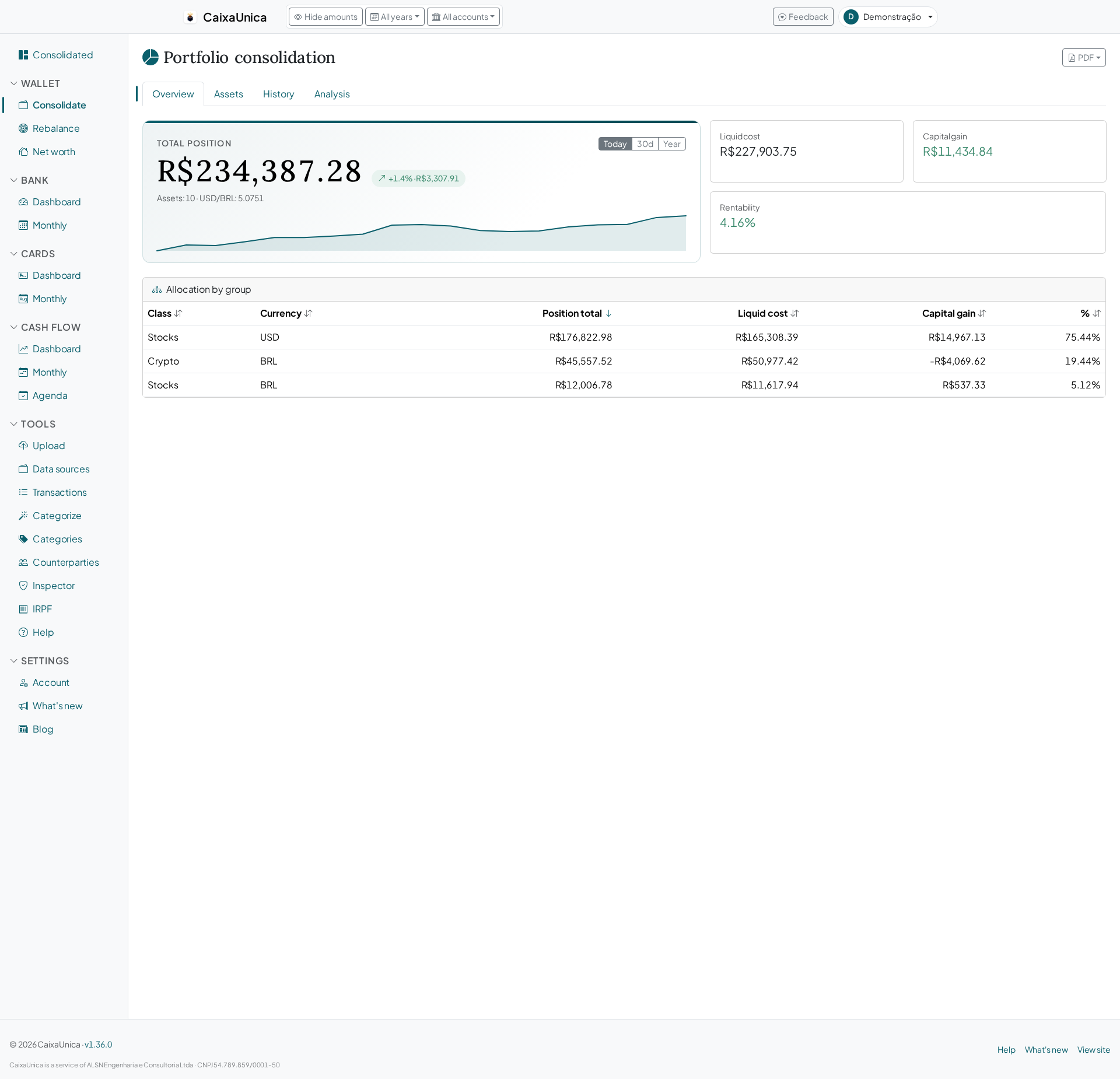
By importing your B3 reports, the portfolio splits the three destinations on its own:
- Recognizes the FII by the ticker — and uses code 07.03 on the Bens e Direitos schedule, instead of treating the unit as a stock.
- Totals the income per fund — what landed during the year goes into the exempt-income bucket, grouped by asset.
- Taxes the sale at 20%, with no exemption — the FII bucket is calculated separately from the stocks one precisely because the rules are not the same.
- Does not confuse a redemption with a sale — a fixed-income redemption does not become variable income just because it left the portfolio; each class falls under its own rule.
What it does not do: offsetting losses automatically across months is still on you, and the report is an estimate for checking — never a substitute for the Receita Federal's own software.
How to start
- Export from B3 the year's trading (negociação) and movement (movimentação) reports — the movement report is where the income and the fund's events live.
- Import both into the portfolio.
- Check the position and the average cost of your FIIs.
- Generate the IRPF report and look at the three sections: Bens e Direitos, exempt income and variable income.
The Portfolio module is part of the paid plans — current prices are always on the pricing page. You can create an account and import the reports to see how it looks with your own funds.
Important: this article is educational and does not replace an accountant or the Receita Federal's official rules. The income exemption depends on conditions of the fund and of the unitholder — if you hold a relevant stake in any fund, or units of an unlisted FII, confirm the treatment with a professional.
Sources
- Lei 11.033/2004 — art. 3: the FII income exemption, its conditions, and the variable-income rates.
- Lei 14.754/2023
— raised the minimum from 50 to 100 unitholders, with a compliance deadline of 30 June
- Lei 15.270/2025 — the 10% withholding on dividends above R$ 50,000 per month, from 2026.
- Lei 8.668/1993 — the law governing FIIs, referenced by code 07.03 itself on the assets schedule.