 CaixaUnica
CDB, RDB, LCI and LCA on your income tax return: what's exempt and what to declare
"Fixed income is no work at tax time" is a half-truth. The tax, when there is one, is withheld at source — you never have to issue a DARF (the slip used to pay federal taxes in Brazil). But the return is still on you: every relevant holding goes into Assets and Rights, and the income goes into different sections depending on the instrument. Picking the wrong section (or forgetting a balance) is exactly the kind of thing the Receita Federal (Brazil's tax authority) cross-checks straight against your bank's income statement.
What pays income tax — and how much
CDBs and RDBs (bank-issued fixed-income certificates) and Tesouro Direto (Brazil's government-bond program) pay income tax on the earnings, withheld at source, on a regressive table:
| Holding period | Rate on earnings |
|---|---|
| Up to 180 days | 22.5% |
| 181 to 360 days | 20% |
| 361 to 720 days | 17.5% |
| Over 720 days | 15% |
Redemptions within the first 30 days are also hit by regressive IOF (a federal transaction tax). Since the bank withholds everything at source, these earnings are exclusively taxed: you report the net amount, but owe nothing more.
What's exempt for individuals
LCI, LCA, CRI and CRA (real-estate and agribusiness credit notes) — and the good old Brazilian savings account (poupança) — have earnings that are exempt from income tax for individuals under Brazilian rules. It's why an LCI can "yield less" than a higher-rate CDB and still win after tax, depending on the term.
Heads up: the exemption covers the notes most people hold in their portfolios today, but the rules for new issues are a recurring topic in Brasília. Before investing on the strength of the exemption, confirm the current rule for the note and its issue year.
Tax-exempt is not declaration-exempt
Here lives the most common mistake. Even when you pay nothing, the investment shows up in two places on the return:
- Assets and Rights (group 04 — financial investments): the balance as of December 31 of the base year and of the prior year, by institution. Since 2022 the tax software uses group codes: 04.02 for CDB, RDB and Tesouro Direto; 04.03 for exempt investments such as LCI, LCA, CRI and CRA — the full table, asset by asset, is in our guide to Assets and Rights codes.
- Income: what your CDB/RDB/Tesouro earned goes under Income Subject to Exclusive/Definitive Taxation; what your LCI/LCA/CRI/CRA earned goes under Exempt and Non-Taxable Income. Your bank's income statement separates exactly these numbers.
How CaixaUnica assembles this for you
There are two paths — and both end in the same place. Through Open Finance (Brazil's open-banking system, on a plan that includes the automatic connection — see the pricing page), your fixed-income positions — Tesouro Direto, CDB, RDB, LCI, LCA — flow into the portfolio on their own, with the balance refreshed on every sync. Rather not connect? Enter each holding as a manual asset — that works on any plan. Either way, when it's time to file, the IRPF module (Brazil's annual income tax return) generates the Assets and Rights section with the right code per instrument — no code table to memorize.
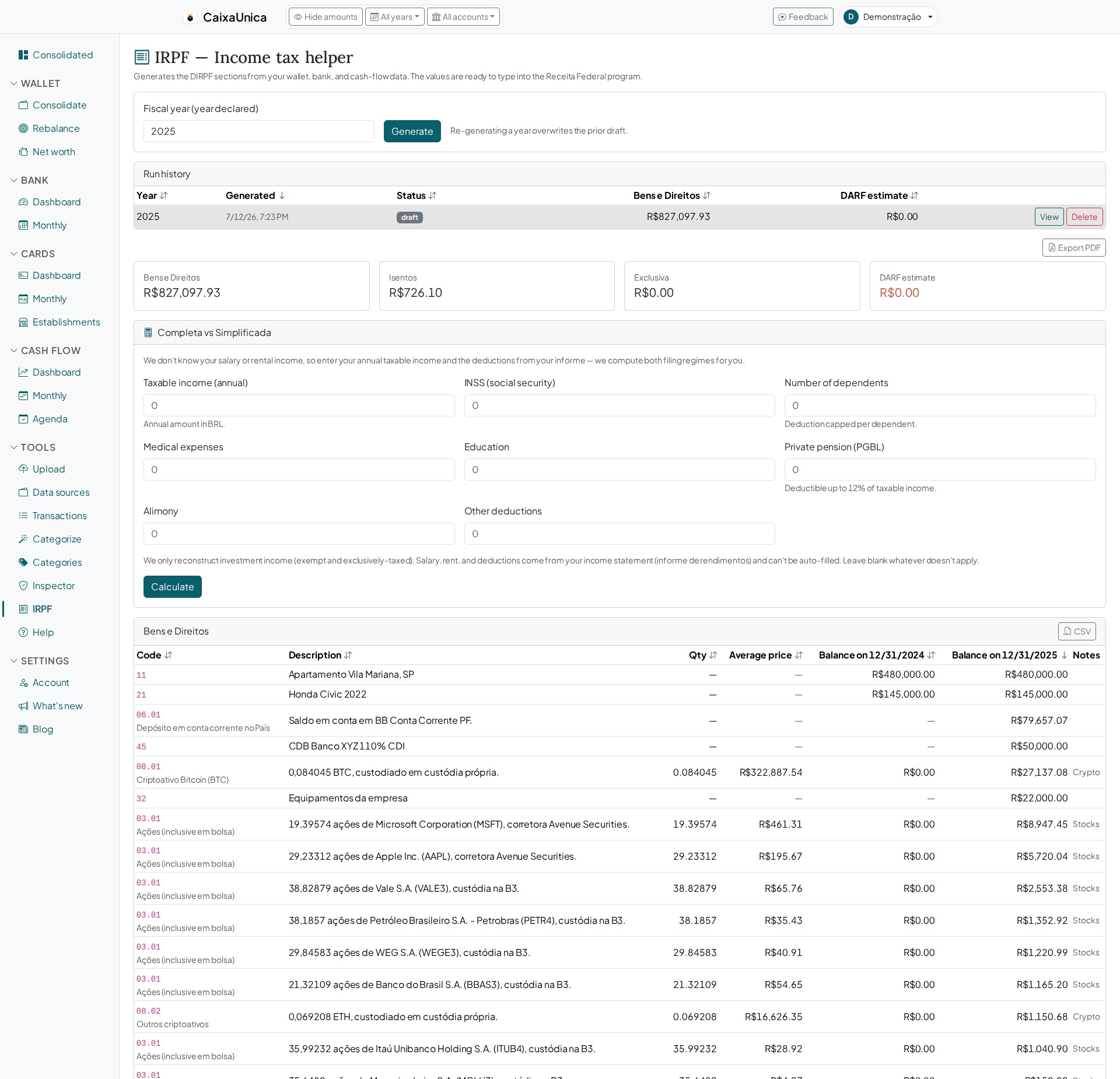
The report comes out ready for review as PDF (for you or your accountant) and as CSV per section, alongside the rest of your portfolio — stocks, real estate funds and crypto, each with its own code.
Quick checklist
- Balance of every fixed-income security as of December 31 entered in Assets and Rights (04.02 or 04.03; savings accounts have their own code, 04.01)
- CDB/RDB/Tesouro earnings under the exclusive taxation section
- LCI/LCA/CRI/CRA earnings under the exempt income section
- Amounts checked against each bank's income statement
Important: CaixaUnica does not replace the tax authority's software or your accountant — it organizes the numbers so you can check and type them in without rework. The rules and codes cited reflect recent years; always confirm them for the year you're filing.
Sources
- Lei 11.033/2004 — art. 1: the regressive table, 22.5% down to 15% by holding period; art. 3, items II and IV: the LCI, CRI, LCA and CRA exemption for individuals
- Lei 8.981/1995 — art. 68, item III: the exemption for savings-account (poupança) earnings for individuals
- Decreto 6.306/2007 — art. 32 and Annex: the regressive IOF on redemptions before 30 days, capped at the earnings
- Receita Federal — IRPF Manual, Financial Assets — the group 04 Assets and Rights types (poupança, taxed securities and exempt securities) and the December 31 balance to declare