 CaixaUnica
How to declare dividends and investment income on your Brazilian tax return
Every year the same scene repeats: tax season arrives and investors discover they received dividends, interest on equity and real-estate fund income scattered across several brokerages — with no idea where each one goes on the return. The good news is that, once you understand the logic, it gets simple. Each type of income has its own tax treatment, and the starting point is always the same: the income statement (informe de rendimentos) your broker gives you.
First, an honest warning: tax rules change from one year to the next. This guide explains the concepts so you grasp the logic, but always confirm the rules for the current tax year and, if in doubt, consult an accountant. The goal here is to prepare you, not to replace professional advice.
What dividends, JCP and other income are
"Proventos" is the umbrella term for everything a company or fund distributes to investors. The three that show up most on the return are:
- Dividends — a share of the company's profit distributed to shareholders. They are paid after the company has already paid tax on its profit, so, as a rule, they reach your account with no additional withholding.
- Interest on equity (JCP) — another way a company rewards shareholders, but with different tax logic: tax is withheld at source when it is paid. For the company it is a deductible expense; for you, the tax treatment is not the same as dividends.
- Real-estate fund (FII) income — the monthly "rent" that Brazilian REITs distribute. They have their own exemption rules and specific conditions set in law.
The difference matters because each one goes to a different place on the return. Treating them all as the same thing is the most common mistake.
Where each type of income usually goes
In broad terms — and always subject to the rules of the current year:
- Dividends have historically been reported as exempt and non-taxable income. You declare the amount received, but it does not add to the tax base. One change to watch: since January 2026, Lei 15.270/2025 (the high-income taxation law) requires 10% withholding at source when the same company pays the same individual more than R$ 50,000 in a single month. Profits earned through 2025, whose distribution was approved by 31 December 2025, remain exempt.
- JCP is usually treated as income subject to exclusive/definitive taxation at source. In other words, tax was already withheld when you received it, and you simply report the already-taxed amount — there is no later adjustment.
- Distributed FII income has its own exemption conditions and generally also falls under exempt and non-taxable income, provided the legal requirements are met. Note: the gain on selling units is a separate story, with its own calculation rules.
Notice I did not cite form sections or field codes: they can change from one year to the next, and memorizing the wrong field creates rework. What does not change is the logic — exempt, exclusive at source, or capital gain. Once you know the category of each type of income, finding the right field in the current year's tax software is the easy part.
Your income statement is the map
Each brokerage and institution is required to give you an income statement with the year's consolidated figures: how much you received in dividends, JCP and fund income, and how much was withheld at source. This document is the official source — declare from it, not from memory or a single month's statement.
The statement also separates amounts by nature (exempt, exclusive at source, etc.), which practically tells you which category each amount belongs to. Keep every statement: they are the proof of what you declared.
The real pain: gathering everything from multiple brokerages
This is where the real difficulty lives. Someone who invests in one place has a single statement and they are done. But the typical investor today has stocks at one brokerage, REITs at another, part of their portfolio at a US brokerage and, sometimes, old positions at an institution they no longer even use.
The result is a puzzle:
- Several statements with different layouts, each covering only part of the portfolio.
- Foreign income, which follows its own rules and requires currency conversion and extra care.
- Manual reconciliation — adding up dividends from the same asset that appeared at different brokerages, checking that nothing was left out, matching amounts received against what was actually credited.
It is precisely in this work of gathering, adding and checking that most errors happen — not when typing, but when making sure everything was accounted for.
Good practices to avoid mistakes
- Download every statement from every institution, even the ones you barely use.
- Sort by nature before typing: exempt, exclusive at source, capital gain.
- Reconcile by asset, not by brokerage — the same stock may have paid income in more than one place.
- Don't forget foreign holdings, which tend to be the blind spot.
- Keep everything for at least five years.
- Confirm the current year's rules and, if in doubt, talk to an accountant.
If you want the full picture of declaring investments, the complementary read on the investment IRPF is worth it.
How CaixaUnica helps with this reconciliation
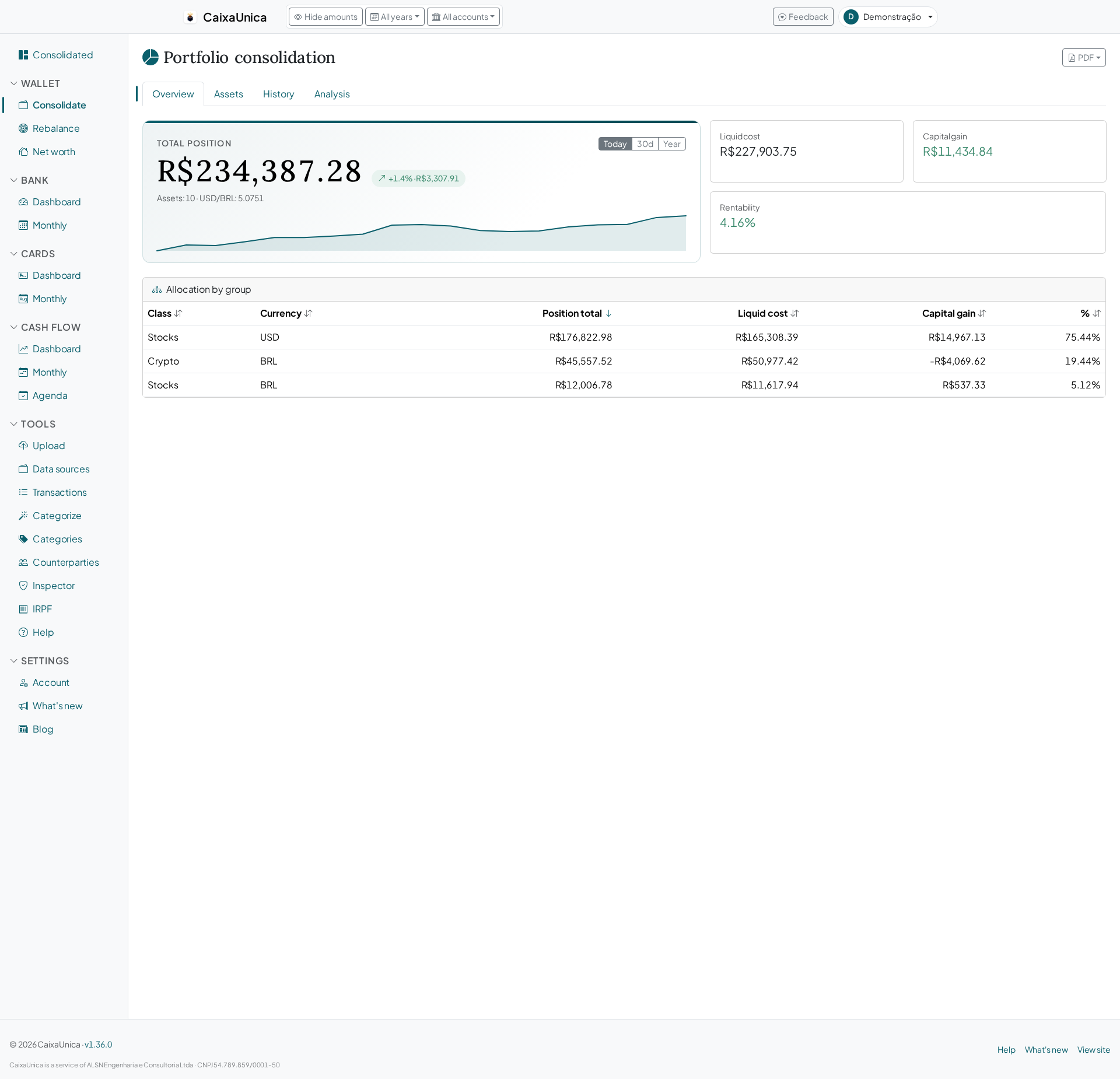
All the tedious part — gathering brokerages, adding up income from the same asset, reconciling statements and consolidating what came from abroad — is exactly what CaixaUnica does for you. You import the statements and notes each institution already gives you, and the platform consolidates everything into a single dashboard, with an investment tax report — exportable as PDF and CSV — for you to use as the basis for filing, without adding anything by hand.
Create your free 14-day account
Sources
- Lei 9.249/1995 (corporate income tax law) — art. 10 exempts profits and dividends from withholding, while art. 9, §§ 2 and 3 subject JCP to withholding at source, definitive for individuals.
- Lei 15.270/2025 (high-income taxation law) — art. 2 inserts art. 6º-A into Lei 9.250/1995: 10% withheld on dividends above R$ 50,000 paid in the same month by the same company to the same individual, from January 2026, with a transition for profits approved by 31/12/2025.
- Lei Complementar 224/2025 (tax benefits law) — art. 8 raised the JCP withholding rate to 17.5% as of 1 January 2026.
- Lei 11.033/2004 — art. 3, III exempts income distributed by FIIs whose units trade on an exchange, and § 1 sets the conditions for the benefit.
- Lei 14.754/2023 (investment funds law) — art. 41 raised to 100 the minimum number of unitholders required for that exemption.