 CaixaUnica
What is Open Finance in Brazil, and why it changes your financial life
For decades your financial data was locked inside each bank. Balance, statement, investments, credit history — all siloed, each institution holding a piece, none of them required to talk to the others. Open Finance flips that: the owner of the data becomes you, not the bank. And that changes how you organize money, compare products and see your net worth.
What Open Finance is
Open Finance is the system, regulated by the Central Bank of Brazil, that lets you share your own financial data across institutions — banks, brokerages, fintechs, insurers — in a way that is standardized, secure and based on your explicit consent. It is the evolution of Open Banking: it started with accounts and cards and expanded into investments, FX, insurance and pensions.
The core idea is simple: if the data is yours, you should be able to take it wherever it serves you best. Want a brokerage to see your history so it can offer better terms? You authorize it. Want to pull five banks into a single view? You authorize it. At any moment, you revoke it.
Why it was created
Before Open Finance, switching banks or comparing an offer was deliberately painful — the lack of data portability kept customers trapped. The Central Bank designed Open Finance to increase competition and financial inclusion:
- More competition — with your data in hand, institutions compete for you with real offers, not fine print.
- Tailored products — credit, investments and insurance assessed from your true history, not a generic profile.
- Real portability — moving relationship, limit and history from one bank to another stops being a punishment.
The phases of Open Finance
The rollout happened in stages, over several years:
- Open data — public information about products and services (fees, service channels), no login required.
- Sharing of registration and transaction data — with your consent, your accounts, cards and credit operations become shareable.
- Payment initiation — paying straight from your account, without a card or boleto, from another authorized app.
- Scope expansion — investments, FX, insurance, pensions and more join the ecosystem.
Today Brazil's Open Finance is one of the most comprehensive in the world, with hundreds of participating institutions.
How consent works (and why it's safe)
Nothing happens unless you say "yes". The flow is designed to keep you in control:
- Explicit consent — you choose which data, with whom and for how long to share. It is not all-or-nothing.
- Term and revocation — every consent has an expiry and can be canceled at any time, from the app where you granted it.
- No password handed to third parties — sharing uses a secure technical standard (authorization directly at your institution), so you never hand your bank password to the other app.
- Regulated institutions — only institutions authorized by the Central Bank take part, under security and accountability rules.
The usual rule still applies: Open Finance is safe by default, but common sense remains — only grant access to institutions you recognize and trust.
What changes in practice for you
- A consolidated view — instead of opening five apps to know how much you have, your net worth shows up together.
- Better offers — credit and investments assessed by your real history.
- Less rework — less manual typing, fewer spreadsheets, less exporting and importing file by file.
- More bargaining power — you stop being hostage to a single bank.
And those who invest in more than one place?
They are exactly who gains the most. Anyone holding stocks on B3, dollars at a US brokerage, crypto on an exchange and accounts at different banks lives the problem Open Finance was born to solve: money scattered, with no single picture of net worth.
Consolidation is the heart of it. Knowing how much you have, where it is, how much it earned and how much goes into your tax return — adding it all up, not piece by piece — is what turns loose data into decisions.
Where CaixaUnica fits in
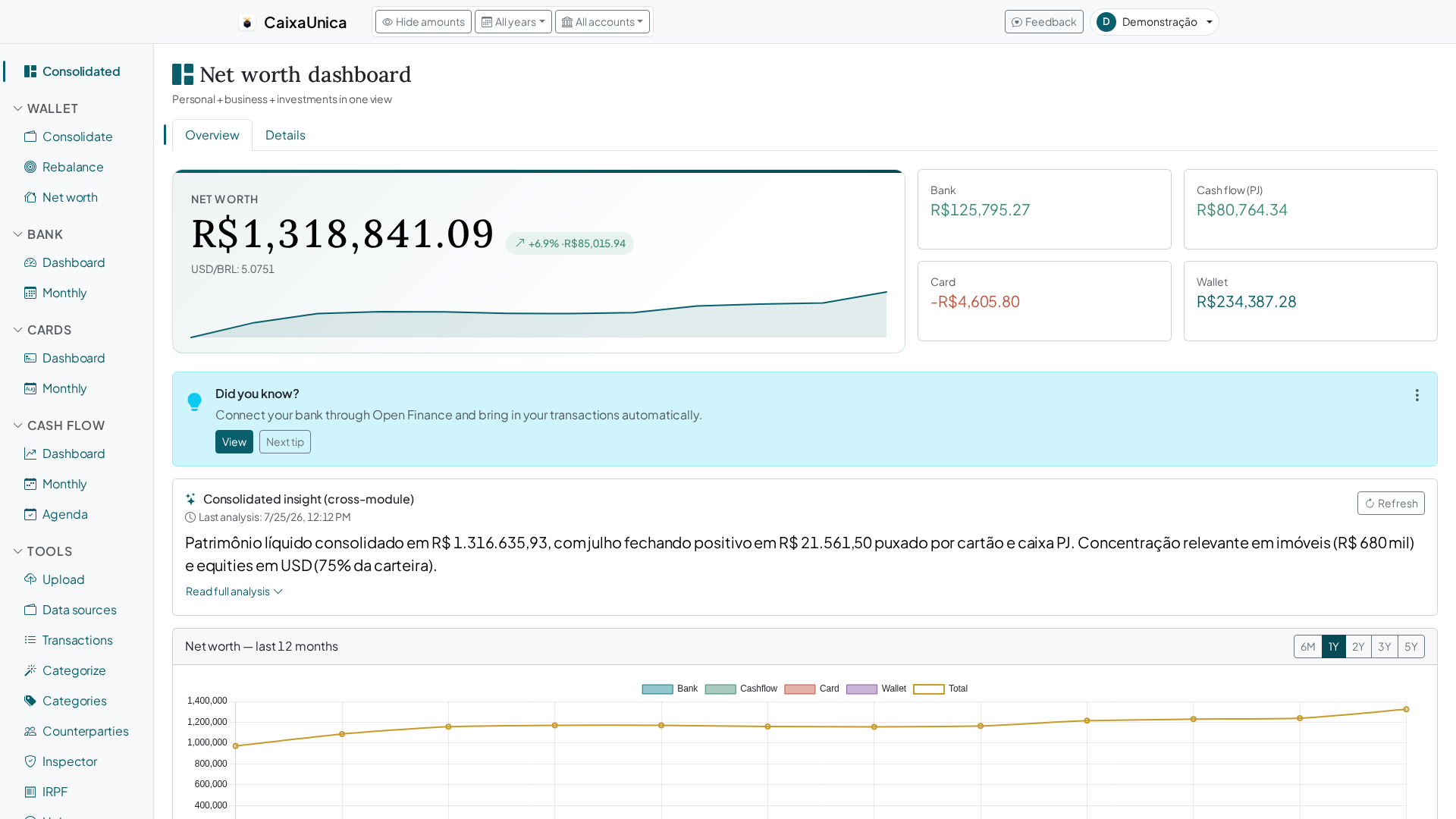
CaixaUnica was built for exactly this pain: bringing B3, brokerages, exchanges and banks into one dashboard, with net worth, spending by category, returns and your investment tax report calculated. And Open Finance is already one of the ways in: you connect your institutions and your accounts, cards and investments start syncing on their own — while whatever your brokerage doesn't share yet keeps coming in through the statements and notes it already gives you.
Either way, the result is the same: CaixaUnica consolidates — without you adding anything by hand.
Create your free 14-day account — every module unlocked, no card details required.
Sources
- Open Finance — Banco Central do Brasil — the regime's official page: what it is, the rollout schedule and the participating institutions.
- Resolução Conjunta nº 1/2020 (BCB/CMN — the joint resolution implementing Open Finance) — the rule behind the regime (renamed from Open Banking in 2022): objectives (art. 3), scope (art. 5), explicit consent with an expiry term (art. 10) and revocation at any time (art. 15).
- Circular nº 4.015/2020 (BCB) — the detailed scope of shared data and services, including FX, investments, insurance and pensions.